Saturday, 22 June 2019

Tetrahedra: Angels of the Tessellated Realm


They are beings of pure Order, hailing from a distant plane in which their bodies tessellate endlessly together. In our world they appear as three-side pyramids hovering in space, fringed with cold fire. Each one surrounded by four smaller pyramids, which in turn are surrounded by yet smaller pyramids, and so on. In the centre of each pyramid is a glowing eye.

 An aura around them forces everything to tessellate with them on every scale. Get too close and you will begin to cough blood as your organs, cells, molecules and particles all try to arrange themselves along a triangular grid.

When threatened they will shrink down to microscopic size. When numerous, they will fuse together into giant pyramids that dominate the sky.


THEIR CULTS

Cultists worship the Tessellated Ones in secret. They infiltrate cities and slowly restructure them according to the divine pattern. First a few geometric sigils, carved at certain key points on the landscape. Palindromic code words whispered from balconies at midnight. Plot the locations of their signs on a map and you will see they are forming a vast overlay of Sierpinski triangles. Another sign is the lowering of local entropy - coin flips start to come in regular patterns of threes.


As Order descends upon the city, the streets themselves subtly realign into tessellating patterns, while the inhabitants' thoughts begin to run on tracks. At last the ground is prepared for the incursion of the Tessellated Ones into our universe.

They come and they dominate us and they make everything run on triangles. Eventually the incursion site becomes a giant hive of tessellated matter - tetrahedral bodies interlocked with octahedral voids. Human bodies are twisted like bound feet until they fit the pattern.

The incursion is just a beach head. Slowly it will spread, until our whole universe is just like their own.


THE REVERSE INCURSIONS

Or will it?


Certain heretical splinters of the Tetrahedra-Cults tell a different story. They tell how, just as the Angels can enter into our world, we can step through into theirs. How certain cultists travelled there long ago and learned to subsist in the spaces between the triangles. How even now they dwell in the infinite plane, spreading like a rot, undermining the perfect pattern.

There are whole towns in that other world, dimensional pirates who use the triangles to raid various parallel planes in search of food and supplies. They have hollowed out vast pyramid-caverns and dressed them with the spoils of worlds.

Because of them, the pattern is slowly collapsing. Vast quakes echo through the plane. Dislocated walls of tetrahedra grind against each other. In their own realm they are powerless to respond to these colonists, as to do so would require them to leave their pattern. Thus their only hope is to seize our own world. Their incursions are not a mission of conquest, but a last desperate attempt at escape.

Wednesday, 19 June 2019

The License to Kill

 What is the function of saving throws in old-school play?
What if their primary purpose was emotional rather than mechanical?
Why roll a saving throw at all? The general consensus around old-school best practices is that severe consequences should be telegraphed by the GM and therefore come as a result of the players' choices. A normal-looking door that shocks people to death is not allowed; but if the door has a sign saying "Keep Out! Wizard's Sanctum!" then it's considered reasonable. If the player tries to open the door, they made a bad choice and now they get the consequence. In terms of fictional consistency, there is no particular reason why there should be a saving throw. "Well, you've got to have some chance of survival." Yes, you already had that chance - it was called "not touching the trapped door"!
So the GM could just say: "You got shocked and now you're dead." But it's very likely this will feeling arbitrary and unfair to the player. The saving throw comes in as an emotional tool to give the GM some plausible deniability. It gives them a license to kill.
Both elements - the bad choice and the bad roll - need to exist for the death to feel fair.
(For death you can substitute any other severe and permanent consequence, of course.)
Perhaps other randomisers in old-school play also serve the same purpose. Look at encounter tables. All of the encounters on the table should offer agency to the players as a baseline. If one of your encounters is "5 red dragons, always attack from surprise" then it doesn't really matter if there's only a 1-in-100 chance of it happening, it's still bullshit. So to flip it around - if none of your encounters are bullshit, then why randomise them at all? Why not just pick whichever one seems appropriate in the moment?
The answer is: you roll so that when the players get into a fight, you have a license to kill.
The truth is it's all you (the GM). You wrote or chose the encounter. You introduced the possibility of death when you called for the saving throw. But the roll itself is a crucial point of emotional distance.
"Aw, sorry buddy. The dice killed you. Not me... the dice."

Monday, 3 June 2019

Dimensional Borer

The dimensional borer is a giant Neuropteran (net-winged insect), distant cousin of the antlion. In its juvenile (nymph) form, it has the ability to burrow through the substrate of reality, creating pocket dimensions from which it ambushes its prey.


The Nymph

The borer's hide appears from the outside as a dark, puckered hole in the surface of reality. It looks the same no matter what angle it is observed from, although the more clever specimens will disguise this by building their hides next to a solid surface.

Space is distorted around the hide, making it look as though it were in the centre of a fish-eye lens. All surfaces slope towards it; loose objects roll into it, and anyone who falls in the area will begin tumbling towards the hide. The hide is always closer than it appears to be, and even basic movements become confusing in its vicinity*.

When prey approaches, the borer nymph sticks its head out of the hole and attack by spitting globs of raw reality at its victims. A direct hit can potentially kill or maim the prey by distorting the space around them. However, the real purpose of the spit is to cause localised ripples in reality that knock the victims down and make them tumble closer to the hide. When they are in reach, the nymph will grab them and drag them inside its pocket dimension.

The pocket dimension is small and dark, a maze of pitch-black tunnels in which the nymph fights at a great advantage. Once the prey is dead, the nymph will slowly suck out the 'spatiality' from the corpse and then spit it back into the world. Such corpses are hideously stretched, nearly weightless, and react unpredictably to contact (think of glitchy ragdoll physics in a videogame).

The nymph's mandibles can be crafted into a unique weapon that distorts enemies' perceptions, although the wielder must train for months before they can avoid cutting themselves with it.

The hide itself will slowly decay if the nymph leaves or is killed. However, with the proper rituals it can be stabilised and attached permanently to a portable object such as a doorway or a bag.


The Mating Season

Dimensional borers remain as nymphs for a long time - up to one hundred years - before emerging all at once in response to some seasonal shift in the shape of reality. In their adult form they resemble giant dragonflies. Once they have left the hide they no longer hunt prey, and will die after a few days. Their mating flights cause dire disturbances in the fabric of reality: time skips, spatial distortions and even brief incursions from parallel universes. The borers mate in midair, after which the female severs the male's head and devours his corpse. She then finds a safe place and thrusts her ovipositor into the substrate of reality to lay her eggs.

While many humans fear the coming of the mating season, others see it as an opportunity. Dozens of hides lie abandoned in the weeks following the mating, and treasure hunters comb the hills looking for them. Additionally, the severed head of the male can be crafted into a shield that draws projectiles like a magnet, and the eggs are worth a fortune to wizards studying translocation.

*Readers of Gene Wolfe's Book of the New Sun can imagine the hide behaving similarly to avern flowers.

Wednesday, 8 May 2019

Social Mechanics for OSR D&D


I'm looking for feedback on this system, which I haven't playtested yet. The purpose is to give more structure to tense social encounters, such as with monsters in a dungeon. The Patience stat puts a time limit on the conversation, and the 'End of conversation' boxes make the stakes clear to the players. I hope this will make the social encounters feel more 'fair' and thus allow the DM to dole out serious consequences if the social encounter goes poorly.

 This system combines a few ideas from OSR bloggers (I don't think I'm the first to come up with a 'Patience' stat) with dice math based on Apocalypse World moves. Design notes are in italics.

The Conversation Game
This subsystem is for use when encountering unfamiliar or potentially hostile NPCs, particularly in the wilderness or dungeons. It is not necessarily applicable to simpler social encounters such as with a quest-giver or a shopkeeper. The purpose is to create tension and interesting choices for the PCs.
These rules refer to NPC (singular) but can also be applied to a whole group.

Basic Procedure
-       When the NPC is encountered, make a Reaction roll to determine their Attitude and Patience.
-       PCs converse with the NPC. Each significant action in the conversation takes one Conversation Turn.
-       After each Conversation Turn, reduce Patience by 1. When it reaches zero, the NPC ends the conversation in a manner appropriate to their current Attitude.

The Reaction Roll
When the NPC is first encountered, roll 2d6 and add the highest Charisma modifier of the PCs’ group. The total amount is the NPC’s Affinity. The number shown on the highest die is the NPC’s Patience. (This is the only place where Charisma affects the encounter. I did it this way so that a player with high CHA gets to feel rewarded, but everyone can still participate in the conversation without being suboptimal.)
 Affinity represents the NPC’s overall disposition toward the party. Patience represents how long they will converse before taking an action that ends the conversation.

Affinity Track
2
3
4
5
6
7
8
9
10
11
12
Affinity Mod
-3
-2
-1
-1
0
0
0
+1
+1
+2
+3
General demeanour
Hostile
Unfriendly
Neutral
Friendly
Helpful
End of conversation
Attacks; flees
Leaves; pursues own goals even if in conflict with PCs
Leaves; pursues own goals if not in conflict with PCs
Offers alliance or gift

(I envision this track on a sheet of paper in the middle of the table, with a token to show where on the Affinity Track the NPC is sitting.)
 
Conversation Turn
A Conversation Turn is an abstract measure of how the conversation has progressed. One Conversation Turn is something that moves the conversation forward and has a measurable effect. One Conversation Turn might cover:
-       A few sentences of back-and-forth dialogue
-       A single important question asked by the PCs
-       One of the specified Conversation Actions below


Conversation Actions

Improve Affinity: Covers all attempts at flattery, boasting, charming, gift-giving, and anything else where the main purpose is to make the NPC like the PCs more.
Roll 2d6+Affinity modifier:
On a 10+, move one step up the Affinity track. 
On a 7-9, the NPC may be unmoved, or may demand a gift or promise; if the demand is met, move one step up the Affinity track. 
On a 6-, the NPC is irritated and one extra point of Patience is deducted.
Bonuses from +1 to +2 can be applied by giving a gift the NPC likes, making a concession (e.g. throwing down weapons), or using techniques relevant to the NPC (e.g. flattery gets a bonus on a prideful NPC).

Make an Offer: Covers all attempts to trade, swap information, make an alliance, etc.
Roll 2d6+Affinity modifier:
On a 10+, the offer is accepted. 
On a 7-9, the NPC makes a counter-offer. 
On a 6-, the offer is rejected. Move one step down the Affinity track.
Bonuses and penalties from -2 to +2 are applied if the offer is unusually favourable or unusually unfavourable.

Make a Threat: Covers all attempts at extortion, scaring away, forcing submission, etc.
Roll 2d6 (no Affinity mod)
On a 10+, the NPC submits to the PCs' will, but moves 1d4 steps down the Affinity track.
On a 7-9, they retreat or make a counter-offer, and move 1 step down the Affinity track.
On a 6-, they attack or flee.
Bonuses and penalties from -2 to +2 are applied based on the relative strength of the PCs versus the NPCs.

Tell a Lie: Covers all attempts at deception.
Depending on the content of the lie, it can instantly set the NPC’s Affinity track to a higher number (e.g. if you convince them you are an agent of their king, their Affinity is set to 11 or 12).
When you tell a lie, roll for its starting HP based on how plausible it is:
Implausible: 1d6-3
Plausible: 1d6
Airtight: 2d6
Add the NPC’s Affinity modifier to this roll.
(I envision a space on the sheet, below the Affinity track, where you can write down lies and put dice to show how much HP they have left. These lies could potentially continue across multiple sessions and multiple encounters with the same NPC.)

Lies
Each lie told has its own pool of HP (Hoodwink Points). If this pool goes to 0, then the NPC no longer believes the lie. A lie’s HP can never go higher than 12.
-       When the NPC sees/hears something that seems to disprove the lie, then the lie takes damage (1d4 for mildly suspicious, 1d6 for quite suspicious, 2d6 or more for blatant contradiction).
-       When the NPC sees/hears something that seems to be evidence for the lie, the lie is healed (1d4 for mild evidence, 1d6 or more for strong evidence).
-       Whenever a lie takes damage, the PCs have a chance to negate the damage if they make up another lie that explains the inconsistency. Roll HP for this lie separately.
-       When a lie reaches 0 HP, it ‘dies’ and the NPC stops believing it. When this happens, all other lies told to the NPC take 1d6 damage (possibly causing a chain reaction) and the NPC’s Affinity track moves down 1d6 steps.

Friday, 3 May 2019

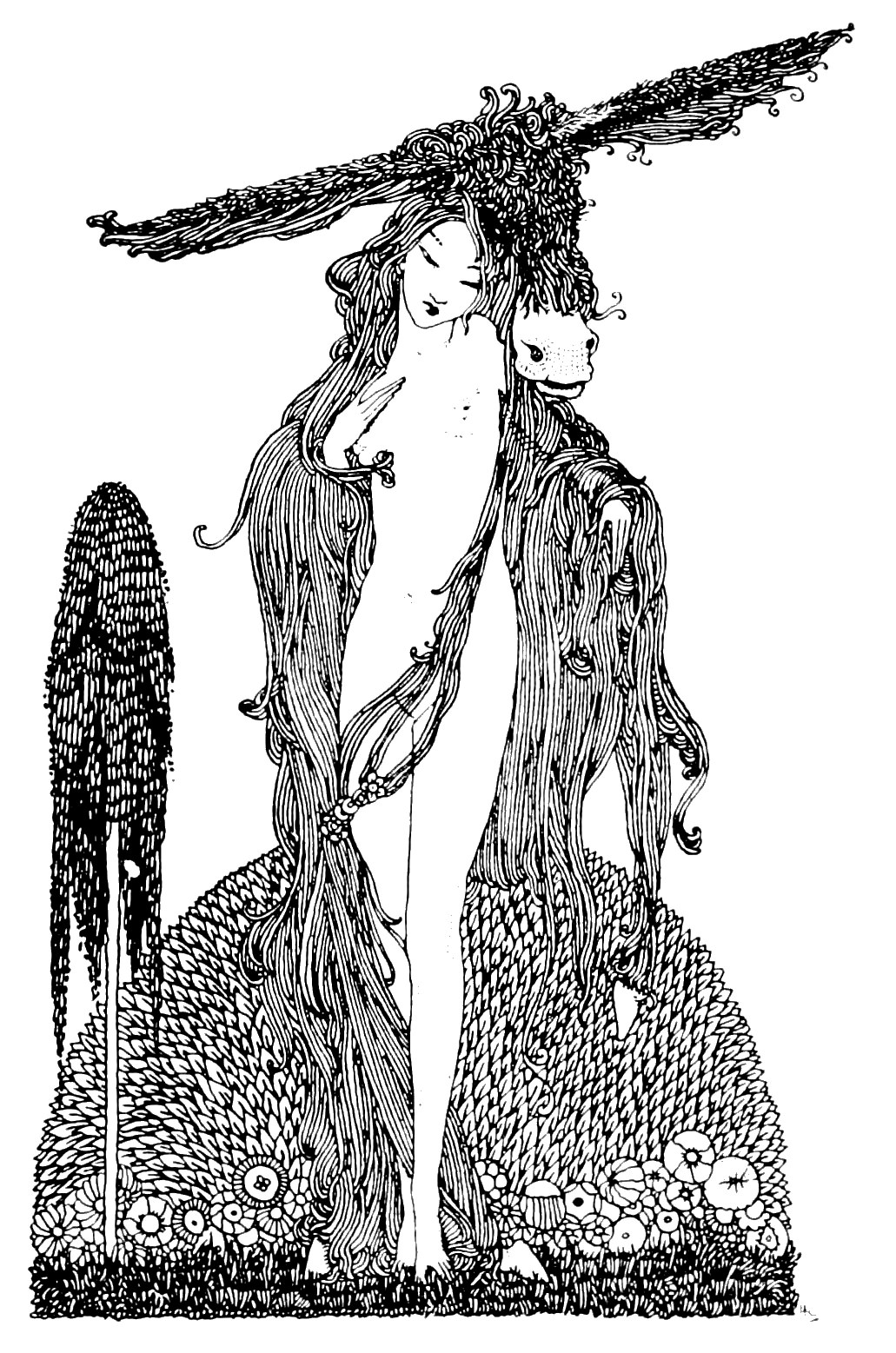
Harry Clarke Bestiary Project: The Bull-Witch

Harry Clarke


An old bull becomes crafty and cruel. He wants revenge on the men who have imprisoned him and used him all his life.

A virgin girl becomes aware of her place in the world, and rebels against it. She wants strength and masculine power, the power to run free and to destroy.

They come together to help each other. The bull knows secret arts that run deep in his veins, memories of a distant age when his kind were still wild. He teaches these secrets to the girl. With his consent she tears off his hide, leaving only a flayed corpse behind.

When she wears the hide under the moon, she becomes a bull. She breaks down the doors of her enemies and tramples them in their beds. When she wears the hide during daylight, the old bull rides her body. He uses her voice to spread lies and hatred amidst the community, spurring men to violence against each other.

As long as she wears the bull-cloak regularly, the girl will not age. To keep it fresh she must leave it hanging on a post in the woods. She must remain a virgin, or the bull-cloak will shrivel and die. Eventually her immortality will become impossible to hide, and she will flee into the forest to become a Bull-Witch.

Sometimes Bull-Witches find each other and form covens. They may be peaceful and reclusive, keepers of secret knowledge; or they may be vengeful witches who work in secret to undermine whole societies. After a Bull-Witch has lived one hundred years, her cloak gradually fades away and becomes a phantom mantle on her shoulders, visible only in moonlight. She/he can shift between forms at will, and his/her mind is one with the bull's.

Human form
HD: 2
AC: Leather
Attack: slap 1d8
Morale: 8
Move: Normal human
Silver tongue: 1/day. Target must save vs. magic or believe whatever the bull tells them. If made to believe something plainly impossible, they instead become feverishly ill for 2d6 days.
Bull strength

Bull form
HD: 4
AC: Chainmail
Attack: Trample 1d8+1 or charge 2d8
Morale: 10
Move: 1.5x human
Shadow step: When in deep shadow, can teleport up to 50' into another area of deep shadow.
Bullfear: 1/encounter. Roar triggers primal fear in humans (save vs magic or flee blindly for 1d6 rounds).

Older Bull-Witches may cast spells as per Magic-User.

Through Ultan's Door Session 3: Pulling Punches

Sidney Syme


In the third session of my Ultan's Door campaign, the PCs went way off the map. This was exciting because I got to use some content I had developed myself; it was also challenging because I had to improvise a lot of things on the fly, which is not my strong suit.

The party found the Great Sewer River which lies at the edge of the map in Through Ultan's Door #1. They took a boat and rowed it upriver, which eventually led them to emerge from the dungeon into the streets of Zyan Above. Some of the party got captured by a group of paranoid Zyanese warriors, while one character made friends with some priests. At one point the party was split into three groups which was quite difficult to run. Eventually, through some fast talking and leniency on my part, they managed to bluff their way into escaping and took the boat back down the river to where they had started.

Overall the session was a success, but there were a few points where I think I could have done better. I felt like I pulled my punches a lot when the PCs were interacting with the paranoid Zyanese. The PCs willingly gave up their weapons and let themselves be captured. Based on what I had established about the Zyanese, it would have been reasonable for them to kill the PCs or at least imprison them indefinitely. Instead I let the PCs get away with some fairly outrageous lies.

I think I was reluctant to make 'hard moves' because I was improvising (therefore the danger was not set in stone like in the dungeon areas I had prepped) and because I failed to properly outline the stakes to the players. Two of the players who got captured were new to this campaign and their idea of D&D is shaped largely by a) comedy D&D podcasts and b) my old Dungeon World campaign. Because of time constraints I had neglected to give them the full 'OSR spiel'. I think they were still in the mindset of "we can say silly things to these NPCs and we might get captured but we'll get free somehow" - which was reasonable, because I had not properly set expectations.

In hindsight, I wish I had explicitly framed the stakes before the PCs gave up their weapons. I should have said: "Look, you don't know who these people are, but they look threatening. If you let them take you captive, you might end up imprisoned or executed. At the very least they will probably take your stuff. Are you ok with that?" Then if the players persisted, it would have felt fair if they got killed.

The other weak point in the social scenes was the lack of dice mechanics. I had been set against using Charisma checks because I wanted it to be OSR style - "you just say what you say and the NPCs react accordingly". But there were several spots where I genuinely didn't know how the NPCs would react, and a roll would have come in handy there. I might start using "reaction roll modified by Charisma" to resolve these situations.

Aside from those points, though, the session was a success and I'm excited to see how the campaign grows from here. Depending on what the players want to do next it could stay as a dungeon crawl, or evolve into a citycrawl/political game.

Wednesday, 1 May 2019

Ritualistic Design

I've been thinking lately about a type of game mechanic or procedure which I'm going to call 'ritualistic design'. By that, I mean a case where the game or gamemaster calls for an action that superficially seems to have a purpose, but actually has no impact on the way the game plays out. A common example of this is the Perception check. Probably everyone reading this has experienced the situation of a GM saying "make a Perception roll", but you know that no matter what you roll the GM is going to give you roughly the same information - or if you fail your roll, another player will "check Perception" and so on until someone rolls high and the GM gets to tell you the thing that they wanted to tell you anyway.


Incidents like these are often seen as failures of design. Many people dismiss Perception checks as pointless. It's bad enough that they waste your precious gaming time on something that doesn't really matter. But also there's a feeling of fakeness that many players react against. It feels wrong to be offered a choice, or made to roll a die, only to realise later that there was actually only one possible outcome. It's like a tiny version of the Quantum Ogre.

I'm definitely one of the GMs who prefers not to use Perception checks in my games. But looking more broadly, I wonder if we shouldn't be too quick to dismiss a game action just because it "doesn't matter" in the grand scheme of things. Here's another example: asking the players "Who's carrying the torch?" as they enter a dungeon. This information might be relevant once in a while. Often it's not. But even if it never affects the game state, it's still an effective way of conveying to the players that they're entering a pitch-black environment - something that might otherwise be handwaved and forgotten.

You could just say "The cave is pitch black. You light your torch, but it sheds scanty light upon the darkness..." But involving the players in the descriptive process gives it more weight, makes it tactile.

Let's go back to Perception checks for a moment. In their "always succeed" mode, they can waste a few minutes of game time but are ultimately harmless. The real problems arise when the GM doesn't realise that what they're doing is a ritualistic technique. They call for a Perception check, everyone fails, and now the adventure can't move forward because the PCs didn't fight the specific clue they needed. The GM thinks the Perception roll is actually part of the game, not just colour.

So this is my recommendation for game designers: don't write off a game mechanic just because it "doesn't matter". Ask yourself if it's effective at setting the mood, engaging the players, developing the world... all sorts of things that don't involve directly affecting the course of the game. If you do use a mechanic in a ritualistic way, be honest about it. Let the GM know: "Everyone should make a Perception check here; the highest check will notice [blah]". Maybe that's a bad mechanic and maybe it's not, but at least if you phrase it that way then everyone can see what it's doing.

I have a new blog about weird old SFF novels

 Well, as you can see I haven't updated this blog in quite some time. I still play D&D but I don't get creative ideas for it in ...